Introduction: The Power of Simplicity in a Complex World
In an age overflowing with images, information, and noise, the art of simplicity has never been more powerful. Minimalism, once misunderstood as an empty aesthetic, has evolved into a bold visual philosophy — one that celebrates clarity, purpose, and emotion stripped to its essence.
For Alex Di Silvestro, minimalism isn’t just a style — it’s a language. It’s how he translates feeling into form and energy into line. Through his self-developed approach, ICONIC ART, Alex proves that art doesn’t need excess to express depth. In fact, true creativity often lies in restraint.
The Origins of Minimalism in Art
The minimalist movement emerged in the late 1950s and early 1960s, as artists sought to break away from the chaos of abstract expressionism. Figures like Donald Judd, Agnes Martin, and Frank Stella began exploring form and space through reduction.
Their message was simple but revolutionary:
“What you see is what you see.” – Frank Stella
Minimalism wasn’t about telling stories — it was about creating experiences. It invited the viewer to slow down, observe, and connect with the purity of visual elements.
For decades, the movement evolved, influencing architecture, design, fashion, and eventually, digital culture. But in the 21st century, minimalism has transformed once again — no longer cold or detached, but emotionally intentional.
The Modern Evolution: Emotion Through Simplicity
Modern minimalism isn’t about removing meaning — it’s about refining it. In the contemporary art world, artists like Alex Di Silvestro bring a human warmth to what was once seen as stark.
Through bold colors, precise composition, and intuitive geometry, Alex’s work captures emotion without embellishment. Each piece reflects balance — between chaos and calm, between complexity and clarity.
Minimalism today has become a form of rebellion — not against art movements, but against distraction. In a world of visual clutter, simplicity becomes an act of focus.
“Every line, every color has a purpose. If it doesn’t serve emotion, it doesn’t belong.”
— Alex Di Silvestro
Why “Less Is More” Still Matters
The phrase “Less is more”, coined by architect Ludwig Mies van der Rohe, captures the soul of minimalism. It’s a statement that speaks beyond art — it’s a mindset, a lifestyle, and a discipline.
Here’s why minimalism continues to resonate in today’s creative landscape:
- It amplifies meaning.
By stripping away what’s unnecessary, the core message becomes louder and clearer. - It evokes emotion.
Simplicity allows viewers to project their own feelings, making the artwork deeply personal. - It celebrates balance.
Negative space becomes as powerful as color. Silence becomes as expressive as sound. - It honors craftsmanship.
Without excess, every stroke, shade, and composition must be intentional and precise. - It’s timeless.
Minimalism never fades — it evolves. Its purity allows it to adapt across decades and mediums.
In essence, “less is more” isn’t about having less — it’s about being more deliberate.
ICONIC ART: The New Face of Minimalism
Through ICONIC ART, Alex Di Silvestro has redefined minimalism for a new generation. His style blends modern design principles with emotional storytelling, creating a bridge between artistic purity and human resonance.
His minimalist language features:
- Clean lines — No brushstrokes, no chaos. Just form and flow.
- Vivid colors — Energetic hues that speak louder than words.
- Emotional precision — Every shape has soul; every subject radiates energy.
Alex’s art isn’t cold minimalism — it’s alive minimalism.
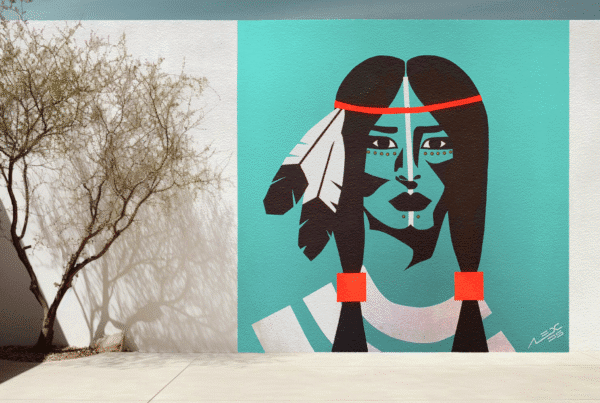
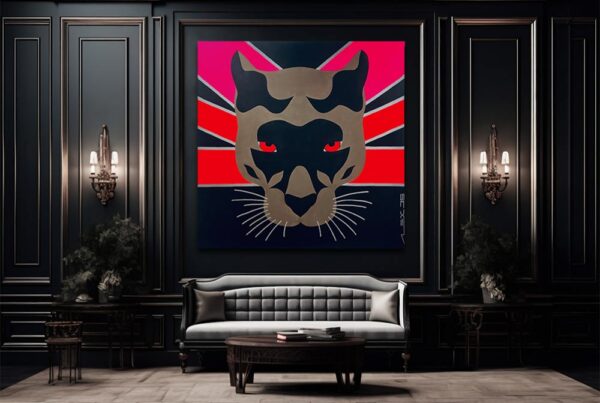
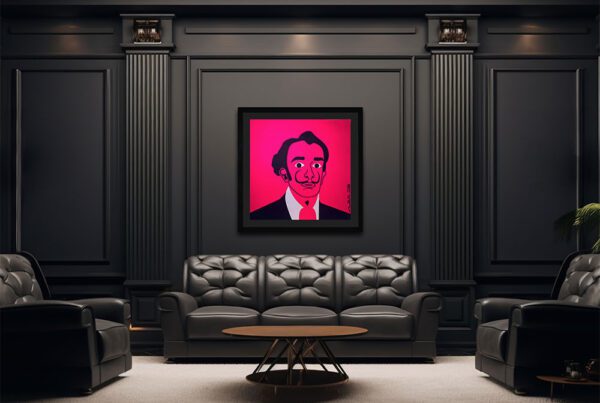
His works — from the ICONIC PORTRAITS to ICONIC HORSES and ICONIC NATIVES collections — embody the idea that simplicity can be emotional, dynamic, and timeless.
“I’m not simplifying to remove. I’m simplifying to reveal.”
— Alex Di Silvestro
Minimalism Meets Modern Design
One reason Alex’s work resonates with collectors and interior designers worldwide is its universal harmony. Minimalist art fits seamlessly into modern spaces — from luxury interiors to gallery walls — because it complements without competing.
A minimalist painting doesn’t dominate a room; it anchors it.
Its clean geometry and bold palette add structure, sophistication, and calmness to contemporary environments.
This makes ICONIC ART ideal not only for art enthusiasts but also for designers and curators seeking artworks that elevate visual storytelling in high-end interiors.
Minimalism as Emotional Intelligence
Minimalism in art isn’t about emotionless design — it’s about emotional intelligence. It requires sensitivity, observation, and empathy to know what to keep and what to let go.
When Alex paints, he begins with energy — the raw emotion — and gradually distills it. What remains on the canvas isn’t less emotion; it’s pure emotion.
This emotional clarity is what connects his art to viewers across cultures and continents. Whether it’s a vibrant portrait or a powerful horse in motion, the viewer feels an instant pull — not because of detail, but because of essence.
Minimalism in the Age of Excess
In a world dominated by algorithms, advertising, and digital overload, the minimalist revolution has become a visual sanctuary. Art like Alex’s offers stillness — a pause between the noise.
His pieces remind us that beauty doesn’t depend on volume, but on vision. That meaning isn’t lost in simplicity — it’s found there.
This is why collectors, interior designers, and modern art lovers are gravitating back toward authentic, meaningful minimalism — art that reflects clarity in both design and thought.
The Timeless Appeal of Minimalist Art
Minimalism transcends trends. Whether it’s the architectural precision of Bauhaus, the meditative grids of Agnes Martin, or the bold symmetry of Alex Di Silvestro’s ICONIC ART, the principle remains the same:
purity of purpose equals longevity of impact.
A minimalist artwork never shouts — it whispers with confidence. It doesn’t demand attention; it earns it. And in that quiet power lies its immortality.
That’s why ICONIC ART continues to attract collectors from around the world — not because it’s fashionable, but because it’s forever relevant.
Conclusion: The Revolution of Restraint
Minimalism isn’t about doing less. It’s about doing enough — with intent, clarity, and purpose.
Through ICONIC ART, Alex Di Silvestro brings this truth to life, proving that simplicity can be the boldest statement of all. His work reminds us that art’s greatest strength lies not in how much it shows, but in how deeply it makes us feel.
In the end, “less truly is more” — not just in art, but in life.
Written by:
Alex Di Silvestro Studio Team